2021年9月13日月曜日

バングラデシュー日本国際交流プロジェクト(2021年8月開催)報告書(5)  小倉千和(国際基督教大学1年)Reflection on the BJEP 2021 (Bangladesh-Japan Exchange Project)(5) Chiyori Ogura (1st-year, International Christian University)  


 このプログラムに参加する前に私が持ち合わせていたバングラデシュに関する知識は、国民の大多数がイスラム教徒であること、アパレルメーカーの繊維工場が数多く存在すること、開発途上国であることの3つのみであった。バングラデシュは私にとって未知の国であったが、プログラムの募集案内を見たときはほぼ反射的に応募を決めた。コロナ禍で思うように外出もできず、家で動画を見て怠惰に過ごしていた私はこの生活に嫌気がさしていた。プログラムに参加し、今まで接点の無かったバングラデシュの学生と交流することで、自分の狭小な価値観や世界がより豊かになるのではないかと期待していた。一方でオンライン上のみの交流で果たして相手と交友を深めることはできるのか、また対面ではないためにミスコミュニケーションや衝突が生じやすくなってしまうのではないかというような不安もあった。だがそのような懸念は、バングラデシュの学生と初めて話した後すぐに払拭された。彼らの明るく、温厚でフレンドリーな性格はZoomの画面上からでもありありと伝わってきたからだ。今回のプログラムでは参加者がそれぞれの生い立ちや経験を話す機会が多くあったが、バングラデシュの学生の温かさが自己開示を促すのに大きな役割を果たしていたのではないだろうか。

 このプログラムの特筆すべき点として、テーマがDeep Cultureであったことが挙げられるだろう。SDGsをテーマにディスカッションやプレゼンテーションを行うような社会課題解決型の国際交流プログラムは、昨今頻繁に開催され、私も以前参加したことがあった。しかしこのプログラムはDeep Cultureというテーマに基づいて対話を行い、他者と比較し自己を内省するという活動が主であった。自己を知ることを目的としたプログラムは確かに国内でも行われているが、それらの多くは就職活動を見据えたものであり、国をまたいで行われることは非常に珍しいのではないか。個々の内面に焦点を当てたプログラムであったからこそ、私は異なる文化的背景・価値観をもつ他者とどのように関係を構築していくか、ということについて再考することができた。プログラムに参加する前は、バングラデシュの参加者を「バングラデシュ人」というように一括りにして捉えていた節があった。だがプログラムが進み、個人の生い立ちやアイデンティに関する一歩踏み込んだ質問をお互いにするにつれて、参加者は各々異なるバックグラウンドや価値観を持っていることが判明し、国籍や宗教に基づいて彼らを一括りにすることはできないのだと実感した。至極当然のことかもしれないが、自分の中の無意識の思い込みに初めて気づかされたのだった。このことが国の代表としてではなく一個人として相手国の学生を捉え、交友を深めることにつながった。またこれを達成するためには、言語や服装、習慣といったの表層的な文化の相違を理解することだけでは不十分である。異なる文化的背景を持つ他者を一個人として捉え相手と関係を構築するためには、目に見えない文化的差異を理解することが欠かせないと私は考える。それは対話を通じて明るみになる意見や価値観の相違について、一体何がこの相違を生み出すのか、またその発言や思考の背景にある前提は何であるかのかを考察することである。プログラムを通して、相手の話を注意深く聞き、そしてその人がどのような人であるかを忍耐強く観察することの重要性を強く実感した。

 忍耐強さは対話における別の側面においても必要不可欠な要素である。プログラムは両国の学生にとって第二言語である英語で行われたため、意思疎通を上手く図れなかったこともあった。特に私は英単語がすぐに思いつかなかったり、伝えたいことを正確に伝えられないことがしばしばあった。けれども他の参加者たちはそんな私に対して途中で投げ出すことなく、質問を投げかけたり、論点を整理したりして最後まで理解しようと努めてくれた。また私が同じ箇所について繰り返し聞き返しても、嫌な顔ひとつせず何度も何度も説明してくれたのだった。たとえ意思疎通が上手く行かなかったとしても、互いが理解するまで対話することを決して諦めてはいけないのではないか。

 この7日間は私にとって非常に充実したものであったと同時に、苦しいものでもあった。プログラムが進行するにつれて、対話のテーマがより一歩踏み込んだものになり、自分は一体何者なのかということについて考えざるを得なかったからだ。自身の過去について振り返り、それを言語化して英語で伝えるということは想像以上に困難であった。さらに他の参加者たちはみな優秀で、個性的であった。英語ディベートで全国大会に出て新聞に取り上げられた経験がある人、海外経験が豊富で様々な国の文化や価値観を享受する人、場を和ますのが得意な人、面白いコンテンツを作れる人、絵を描くことや歌うことが得意な人、リーダシップがある人など、皆が何かしらの強みを持っていた。彼らと自分自身を比較すると劣等感に苛まれた。また参加者の中には将来の展望や目標を明確に持っていた人も多く、専攻すらまだ決めていない私は、目を輝かせながら将来像について話す彼らのことが羨ましかった。彼らのように私にも何かしらの長所や強みがあるのだろうか、理想の将来像とはどのようなものか、私を私たらしめるものは何であるか、自分は一体何者なのだろうか。このようなことをプログラム期間中に絶えず考えていたのだが、残念ながらプログラム終了時までに明確な答えを見つけることはできなかった。けれどもこのプログラムに参加していなければ、これらのことを思案することすらなかっただろう。そもそも自分は何者であるかという問いに明確な答えなど存在するのかは定かではないが、きっと今後も自分に問い続けていくだろう。

 バングラデシュ、日本両国の学生との出会いも、このプログラムでの経験も、今後の私の人生に大きく影響を与えるものとなった。このプログラムに関わったすべての人々に感謝の意を表したい。

Reflection on the BJEP 2021 (Bangladesh-Japan Exchange Project)(4) Alia Shamin (3rd-year, Bangladesh University of Professionals)     バングラデシュー日本国際交流プロジェクト(2021年8月開催)報告書(4)アリア シャミン(Bangladesh University of Professionals 3年)

 Bangladesh-Japan Exchange Project 2021 was an exceptional journey. 

This year’s program set a great example of how much an “exchange program” can impact a person’s life. Most of us have done exchange programs, then why do I say BJEP 2021 was exceptional?


What happens in a usual exchange program? People from different countries meet, exchange cultures, build friendships, learn from each other. And in this pandemic, people can’t even meet, which makes it more difficult to host a successful exchange program. I won’t lie, even I had doubts whether an online exchange program is going to work or not. But to my surprise, AAEE has always proved me wrong. And after engaging in 3 exchange programs back to back hosted by AAEE I can surely say that, yes it works! 


Yet I would say, this year’s BJEP was most exceptional compared to my other experiences. Because of the theme itself! “Deep Culture”


In usual exchange programs, the culture we exchange it’s mostly surface culture. Surface culture shows us how different and diversified are we, how people have different lifestyles, different beliefs, and so on. This is great I would say because exchange programs are meant to break the myopic view where people consider their own culture to be more right or superior? It’s to broaden our mind that we can co-exist having cultures that are very different.


But there’s a loophole. We always brush off just knowing the surface culture and knowing how “different” we are. But what we don’t try to understand is “why” are we different. Just knowing we are different makes us accept the diversity but to “understand” each other which is very important to build friendship, we need to look into the deep culture.


So this year, in BJEP the participants, as well as the organizers, tried to understand the deep culture, what lies beyond this cultural diversity?


Although deep culture is very subjective and tricky to address, the program was well organized. BJEP 2021 started off with a 3-day pre-program where the participants and the organizers had an ice breaker and discussed the surface culture which was essential instead of going straight into the deep culture. It was done to make the environment friendlier so that the participants and organizers interact without any hesitation and feel free to express themselves. In the main 7 day program, the participants dived deeper into understanding each other’s culture. 


What unsaid values do we follow in our society? How has our family and society had an influence in shaping our perception and standards? As an individual what is our own perspectives on these? How our experiences had influenced us to follow or reject certain values?


These were the questions we asked each other. And I realized, even being a part of the nation I never had the chance to really understand my own culture. These questions were thought-provoking. Because even with our daily life these questions are never asked, thus never answered. And through the conversations I had and the ones I listened to, Something struck me. I personally experienced something that I’ve never contemplated or thought about.


We are the same!


I realized that although our social structure, traditions, habits, even some beliefs are really different when we try to engage in deep conversation put our point of view, we have a lot of similarities. 


And even the differences we have, knowing the origin of it, knowing “why did he or she think like that? what’s their perspective?” helped me to understand them better. It made me feel more connected to the other culture.


Hence I would say, this year’s BJEP really opened up my mind, it made me think about my own culture, values, as well as understanding and respecting cultural and ideology differences more. 


Thus instead of getting bombarded with cultural shocks or overwhelmed by cultural differences, BJEP helped us to realize what’s underneath these differences. This is what I dare to say the world needs, to acknowledge diversity, to respect other’s views, and to understand and be more kind to each other. AAEE has done an excellent job creating a platform for the youth to get the opportunity to discuss such unaddressed topics and inspire them to build cross-cultural friendships, promote cultural co-existence, reduce conflicts, and hopefully in long run make this world a better place.


バングラデシュー日本国際交流プロジェクト(2021年8月開催)報告書(3)  片山菜穂(国際基督教大学1年)Reflection on the BJEP 2021 (Bangladesh-Japan Exchange Project)(3) Naho Katayama (1st-year, International Christian University)  

 1. 企画・運営を通して学んだこと

一言で表すと「文化の違いを肌で感じ、どのように適合するか」を学びました。バングラデシュのオーガナイザーとプログラムを創っていくにあたり、何度もミーティングを重ね、一緒に作業をしていくうちに自分の考えと合わないことや、尊重するものや大事にしたいことが違ったりすることもありました。しかし、そのような文化的な違いに直面した時、いったん立ち止まって考え、何事も当たり前と思わず、違う観点があるかもしれないと自分の頭で考えるようになりました。「相手の考え方を尊重する」ことは異文化間だけでなく、あらゆる人と協働する際に必要だと思います。しかし、ただ相手に合わせればいいということではなく、相手がどのような背景や思い、情熱を持ってある言動をしているのかを対話を通して理解して初めて、「相手の文化、価値観を尊重する」ことが出来るのだと学びました。


幸運なことに今までにも海外の人と交流する機会に恵まれましたが、このプログラムを通して、バングラデシュのオーガナイザーと、今までの仲良くなることとはまた違う経験をさせてもらったと感じています。取り組んでいく中で、大事な決断を下さなくてはならず、何時間も真剣に話し合いをしたり、予想外の展開となり、予定を大幅に変更したり、ミスコミュニケーションで理解に齟齬が生じ、それをしっかり話し合って解決したり、本当に多くの壁を共に乗り越え、それを通して相手の性格や考え方、生きる軸となるようなものまで知り、「深い」関係を築くことが出来ました。また、社会や生活環境の違いを突きつけられ、その中で自分を改めて考え直させられる機会にもなり、視野が広がりました。チームの中で自分が何を出来るのか、それをひたすら考えながら挑んだ数ヶ月。今回の経験は確実にこれからの私の生き方に影響を与えると確信しています。


2. 参加者から学んだこと

バングラデシュの学生から学んだことは、「自国に誇りを持つ」ことです。自国の文化や社会問題、政治、あらゆることに関して、知識が豊富な人が多く、更に、とても嬉しそうに自分達の国を紹介する姿が印象的でした。「バングラデシュのことについて知りたかったら何でも聞いて!」と言ってくれたり、「バングラデシュの人々は、自国がインドやパキスタンと混同されやすいから、アイデンティファイしたくてよくしゃべるんだよ!」というふうに教えてくれたりする人もいました。確かに、日本の文化は海外でもよく知られているものも多く、海外の人と交流した時も、説明するまでもなく知っているという状況も珍しくはありません。有名な文化については「自分で説明し、伝えていく必要性があまりない」ために自然と自分の文化を伝えよう!という気持ちがバングラデシュほど強くはないのかもしれない、と気付きました。ですが同時に海外の人には知られざる日本文化の魅力は余るほどあります。海外の人と交流をする際に、相手の文化を教えてもらうお返しに、自分が日本の奥深い文化を魅力的に伝えられるよう、日本文化にもっともっと触れようと思いました。


また、自分の過去や考え方などについて真剣に語り合う参加者皆を見ていて、「誰にでも今まで辛かった過去や必死に頑張ってきたこと、本気で悩んできたこと」があり、それを言語化して共有することで他者のストーリーを知り、自分を客観視することが出来るのだと学びました。ある学生が、「みんな悩みがある。けどそれを共有できず、一人で抱え込んでしまっているだけ。私達は今回こうして共有することが出来て、悩んでいたのは自分だけではないということが分かって勇気をもらった。だから、みんなが自分の内面を共有し、考えられるようなプラットフォームがあったらいいな。」というようなことを話してくれました。私はその子の意見に強く共感したと同時に、「参加して勇気をもらった」という言葉に胸がつまりました。育つ環境が違うと備わる視点や価値観も異なり、それは異文化間交流に留まらず、日本人や日本国籍を持つ人の間でも言えることです。今回のプログラムを通して、一つの話題に対して、様々な視点から、異なる意見を聞くことが出来る「多様性」の可能性に身をもって気付かされました。


3. オーガナイザーの愛

BJEPで一緒に活動したオーガナイザーは皆能力が高く、強みを持っており、沢山助けてもらったと同時に多くのことを学ばせてもらいました。責任感の強い人、コミュニケーション能力が高く、その場を和ませるのが上手な人、MCが上手な人、クリエイティブな人、記事を書ける人、人脈が豊かな人、優しさに溢れている人、議論をまとめるのが得意な人、みんな違った強みや個性を持ち、それぞれが自分の役割を果たしたからこそやり遂げることが出来たのだと思います。このメンバーの暖かさ、最高でした!!毎日睡眠時間を削って、プログラムの成功のために頑張ったり、テストの合間を縫ってZOOMに顔を出し、「みんなと早く会いたかった~」と笑ったり、各オーガナイザーのBJEP2021に懸ける思い、そして粘り強さがこの素敵な雰囲気とBJEP2021の成功をもたらしたのだと思います。


本当にありがとございました!!!!

Reflection on the BJEP 2021 (Bangladesh-Japan Exchange Project)(2) Rehnuma Taskin (1st-year, Rajshahi University of Engineering & Technology)   バングラデシュー日本国際交流プロジェクト(2021年8月開催)報告書(2)レヌマ タクシン(ラジュシャヒ工科大学1年)

                                                Rehnuma Taskin
 (1st-year, Rajshahi University of Engineering & Technology)  


Just some days before the registration closes, I applied to be a part of the Bangladesh Japan Exchange Project 2021; I never thought it would turn into one of the best decisions I’ve made in my life. After being selected, I felt sad as it’s happening online, so I’m missing out on the chance to visit Japan. However, the whole program changed my sadness into a basket of happiness and warm memories. 

 The night before our first pre-program day, I was a bit scared; would I adjust to all of them? Will the Japanese accept me gladly into their conversations? Or what is going to happen if I say something wrong that will make them upset? All the doubts got cleared after our first session. I was warmly accepted into this peer group and felt perfectly comfortable; the sky of self-doubt just vanished like magic! 

We had three pre-programs days where we discussed our surface culture such as, languages ( I loved all those Japanese words! ), food habits, clothes, festivals, songs,  and many things more. The most exciting day was day 02 where we all were in our traditional clothes and brought food online! As Bangladeshis and Japanese have different food habits and eating rituals, we ate in front of our camera and showed traditional foods to each other. 

For me, the topic seemed pretty hard, but a big thanks to our professor and organizers. They divided the entire session into different modules that make all of us understand the topic deeply. Our main program was hosted from August 22 to August 27, following the closing ceremony on August 28. On our first day, we discussed a general introduction. Day by day, we entered into social pros and cons, our family structure and the differences, our country facilities and educational interests, and so many things. These things led us to the core part of this program, the “Deep Culture”.

We all searched our memories of childhood to find out what influences we had as a child. And then the most beautiful thing about this program happened. We started to know ourselves. We dug down and talked about our fears, values, and norms, some unforgettable incidents that many had locked down in our hearts. We shared all of these beautiful life stories with each other. The person I was talking to at that moment had to endure a long journey to come into this position. The human we became were based on our life lessons and thoughts of life. Some of us were religious, and some weren’t, but we learned to respect each other’s values and perspectives of seeing life. Some had problems like inferiority complex, some had a fear of mixing with people or going to school, but none of this stopped us from being good humans or helping each other grow. 

The support I got from these people is life-saving. Their warm words and caring gestures made me so comfortable that I felt I could talk to them continuously all day. Not for a second, I felt that I know these people online and have just met them for 3 days. I felt they are my long-lost friends whom I’ve reconnected with through the internet. We all felt sad, realizing that this program is going to end on August 28. 
After that, we won’t meet these fantastic people regularly. 

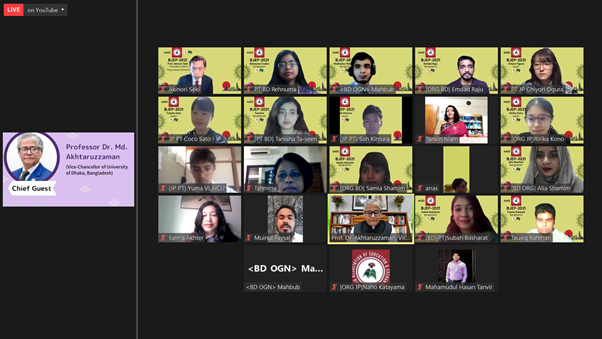
The organizers kindly arranged a big closing ceremony for us. And we became too glad to see our honorable chief guest, Vice-Chancellor of the University of Dhaka, Professor Akhtaruzzaman, inaugurating the ceremony. We also had renowned professors from universities as guests on our closing day, which gave us the joy of hearing from wise minds. And the reflection wouldn’t end if I don’t share the tales of Professor Akinori Seki. This one-man-army monitored every single thing of this program along with helping participants to flourish themselves more. My heartfelt respect to Sir for guiding us throughout the sessions, and I’m blessed to meet him and taking his guidelines. 


Before I joined this program, I was a person who just used to exist for her life, not living it—like every day following the same routine, joining my zoom classes, completing my assignments and exams, doing some work online, and then sleeping again. But, after joining this program and hearing the word “ Deep Culture” for the first time in my life, I get to know about myself; I got introduced to the Rehnuma Taskin living inside me for so long. This program gave me a new perspective of my life; I learned to believe in myself from the participants. When we had all our discussions in breakout rooms, it may not be essential to outsiders, but all those brainstorming help understand our lives and how we have evolved as humans. The deep culture seemed far more profound than we thought before. In search of new friends from Japan, I also get new dimensions of my life. Bangladesh and Japan may have the language barrier, cultural barrier but our thoughts as a human helped each of us to recheck our deep culture.

2021年4月2日金曜日

2021年春期 四か国(ベトナム・バングラデシュ・ネパール)UNITE参加報告書(4)池内萌(東京大学工学部2年)

UNITE was a rollercoaster of new experiences: many fun, most engrossing, and all valuable. Above all, UNITE was a chance for me to learn and grow. I would like to pick up three elements where I felt I flourished the most and explain why it was possible, and how it is important.  

Firstly, and most obviously, my attitude towards environmental problems. This was achieved through three different factors: the main theme, the effect of four countries joining together, and the program schedule. Since UNITE was a place where students from all over  Asia could join together and discuss environmental issues as one, it was only natural that my interest for such problems would grow. Although I had a vague idea on the back of my mind that the environment was in danger, and that some action had to be taken, it had stayed a  mere idea until UNITE brought it to my attention. More importantly, the fact that four countries participated in the event had a critical effect. Living in Japan, it is too easy to become blunt to the problems occurring around the world. However, a participant from  Nepal changed my lukewarm attitude completely. He talked about Kathmandu, the capital of Nepal, and taught me in great detail of the environmental issue it was facing, namely air pollution. It was eye-opening how somebody my age was seriously contemplating and educating oneself on environmental issues.

As the program continued, I learned about other problems in other countries. In Bangladesh, plastic disposal and plastic wastes were harming the environment, in Vietnam, water and soil pollution was a serious problem. Hearing other participants made me realize that environmental problems were not a topic for safekeeping in your mind, it was a very real, actual issue that needed to be taken care of as soon as possible.  Moreover, when asked about the issues surrounding Japan, it was astounding how textbook knowledge was the only thing I could come up with. This was another reminder of my disinterest and a lesson to myself that I had a long way to go before I could be on the same lines as the students from different countries. Finally, I would like to briefly point out the way this program was organized and how it was effective. The program was for 7 days, and each day was 5 hours of discussing, debating, and researching. According to Ebbinghaus’  forgetting curve, repetition and intensity are key elements that ensure that learned material is not lost and forgotten. The program schedule was in accordance with this fact. For all these reasons, I believe UNITE altered my unenthusiastic behaviors towards environmental issues and made me not only interested but eager to take action.


Secondly, English and communication using English. To explain this part, I would like to walk you through the program and point out the how and why. Although officially UNITE  is for one week, there was actually a pre-program the day prior. It had been quite some time before I took part in any English conversation, let alone with members from all over the world. What I had been anticipating was not being able to translate my opinions into  English. However, the pre-program helped me clear my anticipation. The pre-program started with brief introductions and ice-breaking; since it only required very simple English,  it helped me ease my mind into using English. After warming up for a bit, the participants were put into smaller groups and made to discuss a movie and news articles on environmental issues. Since I had quite some time to prepare, the discussion went smoothly and made me confident and comfortable in using English. This mentality was important, as it gave me the courage to speak up and express my opinion. Days 1 through 3 were spent getting to know each other and the main theme at hand. After becoming confident in the material,  days 4 through 6 were spent with team members, getting ready for the final presentation. It was especially hard work coming up with an interesting topic to work towards, and even harder work making a feasible and innovative solution; it could not have been done alone. It was like carpentry: cutting, shaping, and polishing to perfection. UNITE met its finale with the final presentation: each team was supposed to give a 10–15-minute presentation with  Q&A. To think on the spur of the moment and answer questions was quite an experience:  but a satisfying time indeed. As I have shown you, UNITE had a packed schedule, and  English was the only choice the whole time. Whether you were reading articles and papers alone, or talking and working with your group, or giving a speech/presentation, the only way to make yourself understood was in English. Through the 8 days I spent working on UNITE,  I was able to exercise and brush up my English skills. With COVID 19 and my university classes (very science-focused), it was difficult to make time studying English let alone using it fully. Therefore, UNITE was a valuable opportunity. 

Thirdly and most importantly, mental growth. Although UNITE’s official goal is to “come up with an innovative and feasible solution to environmental problems'', I believe the true goal  was to learn from the other participants and advance as a person. Mentally, I learned three valuable lessons: stepping out of your comfort zone, follower and leadership, and enthusiasm to learn. Let me explain: UNITE was a continuous experience of stepping out of my comfort zone. To begin with, deciding to apply for UNITE was a challenge in itself. As I  have explained before, I lacked confidence in my English skills, and since I am a very inverted person, I feared not being able to make new friends. Thanks to spring vacation and my friend’s (in AAEE) presentation abilities, I made the first leap. Just because I was able to join UNITE didn’t mean everything would go smoothly after that. I was always nervous when speaking in front of everyone or even just speaking up in my group. I am the type to keep silent even when I don’t understand because I might make a fool of myself. However,  to give the final presentation, it was critical that I understood every aspect of what my group’s presentation was about. If I had even a small question, I had to ask up. This trial made me step out of my comfort zone a little easier: I would risk looking foolish for not understanding. Next, I learned how to work in groups. Obviously, this was not my first experience working in a group. However, previously, all my group members were somewhat similar to me: same school, same interests, same country. UNITE’s group was a different case. With four people from four different backgrounds, it was much harder. Through working together in my team, I learned to both follow and lead. Since I’m somewhat confident in my summarizing abilities, I took initiative when I felt we were straying off-topic.  When taking leadership, I had to give concise instructions and be sure of my decisions.  When following the leader, it was important to support the leader; give feedback, engage,  and encourage. Switching back and forth between the two, I feel that my ability to work as both improved. Last but not least, I regained my eagerness to learn. My role as a university student is to learn; I have heard the tired old saying countless times. Daily procrastination and quick and cheap entertainment made me forget such mentality. As I have already mentioned, my fellow members were eager to learn not only about environmental problems but to learn in general. Their frame of mind reminded me of my duties and inspired me to start studying for the spring semester. UNITE’s selling point is the four countries joining together. If it was not for this, I highly doubt I would have been able to grow so much. Such a mindset can only be valuable in my life, and I cannot thank AAEE enough for the opportunity.  

I have talked about three areas where I felt particular growth: attitude towards the environment, English, and mentality, but this is just the tip of the iceberg. UNITE was a  hubbub (in the most respectable and positive meaning) of new culture, new experiences,  and new friends. I would like to rest my pen with thanks to all the participants and organizers and hope that my time in UNITE had made the Earth a little kinder planet to live in. 


2021年春期 四か国(ベトナム・バングラデシュ・ネパール)UNITE参加報告書(3)宮口貴義(金沢大学大学院人間社会環境研究科地域創造学専攻1年)

 「4カ国の温かさに触れた7日間」


参加動機と最初の印象


 私がこのプログラムに参加した動機は、単純に「外国の人たちとたくさん喋りたい・英語力を向上させたい」というものでした。コロナ禍において留学もしばらくは出来そうになく、せっかくの春休みを利用して国際交流など何か貴重な経験をしたいと模索していたところ、このプログラムを見つけました。費用もかからず、7日間という長さも丁度良く魅力的に映ったため応募しました。テーマは「環境」でしたが、環境問題に日頃から特別関心があったわけではなく、参加が確定してから急ピッチで環境問題について自分なりに調べ、専門用語的な英単語も地道に覚えて準備していました。私は学部時代、学校教育学類の保健体育専修に所属しており、大学院でもスポーツ心理学の研究をしています。はっきり言って、国際交流とは無縁で英語もほとんど喋れませんでした。このプログラムの参加者のほとんどは英語を不自由なく喋ることができます。その輪の中に飛びこんだ私は、専門分野も違いますし、結構変わり者というか珍しいタイプの参加者だったと思います。最初は、本当にコミュニケーションが取れるのか不安だらけで、実際他の人の発言を聞き取るのにもかなり苦労し、8割くらい聞き取れていなかったと思います。


5つのグループに分かれてのプレゼン準備


 環境問題に関して、「Fire」「Water」「Soil」「Air」「Life」といった4人ずつの5グループに分かれました。各グループには4カ国から1人ずつ入りました。オーガナイザーの方も各グループに3、4名ずつ入り協力してくださいました。当然、私のグループは日本人1人で初めは中々言いたいことを言えなかったのですが、同じグループのバングラデシュ、ベトナム、ネパールの仲間がびっくりするくらい気さくで優しく、何度も助けてくれました。次第に皆の話している内容が分かってくるようになり、自分の意見も伝えられました。グループメンバーの時間の都合が合わず、苦労したことも多かったですが、それはそれで自分が成長するための時間になったのではないかと思っています。特に、皆で苦戦したのはこのプログラムの最終目標である「実現可能で、独創的な解決策」を考えることでした。このプログラムでは、環境問題に関する5つの各トピックに対して、現在の世界の状況を調べ、「実現可能で、独創的な解決策」を考える必要がありました。それが最も難しく、頭をひねっても中々良いアイデアが思いつきません。環境問題に対してもっと知識が必要だったというのももちろんですが、自分の独創性の乏しさを痛感しました。


 このプログラムでは、4カ国の学生が混ざった環境問題グループの他にも、各国のプレゼンのために日本人の参加者だけで話し合う機会がありました。そこで私は日本の他のメンバーに、自分のグループでは独創的な解決策が思いついていないことを打ち明け、アドバイスを求めたところ、「環境デザインとか利用するのどうですか?」とアドバイスを貰いました。そこで私はハッとし、環境デザインは私が大学院で専攻している心理学とも大きく関係していることに気づき、「どうして今まで自分は、せっかく学んでいる心理学を環境問題の解決策に生かさないんだ?!」と気づかされたのです。専門分野は違えど、違うからこそ異なる視点で物事を捉えられるのではないかと思いました。結局、心理学を十分に生かし切ることが出来なかったと思うので、それが唯一の心残りです。しかし、それは私の専門分野への勉強に対する更なるモチベーションになったことは間違いありません。物事を広い視点で捉え、専門領域を超えてでも生かせることを見つけていくというのは、非常に重要なことだと感じました。アドバイスをくれたメンバーたちには本当に感謝しています。


最終日~プレゼンを終えて~


 プレゼン本番を終えて、ホッと一安心したと同時に他のグループの発表がどれも素晴らしく、学ぶことが大いにありました。どのグループも本当に頑張っていたんだなという気持ちでした。環境問題に対して知見が深まり、そしてそれは日本の状況だけを見ていては気づけないこと、アジアの他の国の学生の意見を聞くことで新たに知ることがありました。環境問題は、隣国から地球の裏側の遠い国にも影響を及ぼしており、国同士で協力しなければ解決できないため、このように4カ国の学生どうしが意見を交わし合うというのは重要な機会だったと思います。


 最終日の夜は、打ち上げ的なイベントがありました。ゲームをしたり、歌やギターなど特技を披露する人もいました。日本グループは「花は咲く」を各々が歌って録音したものを音楽編集技術に長けたメンバーが一つに合わせてくださり、それを流しました。日本で10年前に起きた震災を思い出させるこの曲を他の国の人たちが一緒に聴いている。何とも感慨深いものがあり、それと同時にお互いの国のことをもっと気にかけようと思いました。


最後になりますが、このプログラムはAAEEの関先生やオーガナイザーの人たち、参加者の人たちなど様々な方々の尽力無しには成立しませんでした。オンラインでもここまで出来るのだと実感しました。実行する上で何度も困難があったとも聞いています。それでもやり遂げてくださったことに本当に感謝しきれません。私の人生が変わりました。そして、プログラムで出会った仲間とは今後もつながりを持ちながら、いつか実際に出会えることを心から楽しみにしています。


2021年春期 四か国(ベトナム・バングラデシュ・ネパール)UNITE参加報告書(2)多賀谷美聡(上智大学総合グローバル学部1年)

  私は3月半ばの1週間、AAEEが主催する4か国協働プログラムに参加した。この報告書で伝えたいのは、一つ目に「運営の方の支えで乗り越えられたこと」、そして二つ目に「自分が日本に対していかに無知であるかを感じたこと」だ。

 私にとってのこのプログラムは、正直に言って、楽しさよりも辛さの方が圧倒的に多い経験だった。自分の拙い英語、そして国ごとの発音の微妙な違いにより、まず自分が伝えたいことをチームメイトに全く分かってもらえない。それどころか、チームメイトが何を喋っているのかもほとんど分からない。加えて話し合いのトピックも「サンゴ礁保全」と、自分が関連知識を持たない分野であり、難しかった。

 そもそも私がこのプログラムに参加した動機は、環境問題に向き合うこと。このプログラムの少し前に別団体のグローバル・プログラムに参加しており、そのプログラムも環境問題をテーマとしていた。しかし、その場では国際交流に終わってしまい環境問題に対して深く考えることができなかった。その悔しさを晴らすため、今度こそ国際交流で終わらずに本気で環境問題に取り組みたいと、AAEE主催の当プログラムに参加したのだ。

 だからこそ、海外の人と仲良くなるという部分には、楽しいだろうという期待があった。環境問題は難しくてつまずくかもしれないけど、海外の人との交流が楽しすぎて乗り越えられるだろうな。そんな風に思っていた。

 ところがふたを開けてみれば、意思疎通すらできなかった。言いたいことは山ほどあるのに何も伝えられない、聞き取れない。でも最終日までにチームで「innovativeでfeasibleなsolution」を出さなければならない。英語で話すことが次第に怖くなり、私はディスカッション3日目には黙り込んでしまうようになった。

 そんな状態の私であったが、最終的にチームでプログラムを走り抜けることができた。もうこの際だから書いてしまうが、途中で何度リタイアしようと考えたか分からない。私がなぜ最後までチーム活動に参加することができたか。それは絶対に、周りの方々の支えがあったからだ。

 まず、プログラムのオーガナイザーの方々。本当に感謝してもしきれません。チームでのディスカッションの様子を常に温かく見守って下さり、時に通訳や、議論を前に進めることまでしてくださいました。特に私が支えられたのは、あるオーガナイザーの方が私にくれた言葉。「トライして、みんなに心を開いてもらえれば成功する。」、本当にこの言葉の通りだった。自分の意見を上手に伝えることが出来ないのなら、まずはチームメイトに心を開いてもらえるように頑張ろう、それなら私にだって出来る。そんな考えから、チームメイトにこまめに感謝を伝えたり、チームメイトの言ったことに絶対に反応することを徹底したりと努力した。すると、チームメイトとの距離がみるみるうちに縮まり、私の拙い英語を何とかくみ取ろうとよりいっそう努力してくれるようになった。チームでのディスカッションも少しずつ軌道に乗り始め、私たちのチームは最終的に賞をいただけた。この変化は、当プログラムにおいて失敗ばかりだった私にとって、一番に嬉しい成功体験であった。「チームメイトもきっと私と同じように、思うように進まないチームの状況に苦しい想いをしていたのだろう」と、遠く離れた地にいる他者に想いを馳せることが出来た瞬間でもあった。

 またプログラム期間中、同じ日本参加者の方や関先生にも、大いに鼓舞していただいた。伝えたいことが伝わらない苦しみを分かってくれる人がいることが、どんなに支えになるのかを実感した。きっと私はこれから英語を使って誰かと関わる度に、お二人との温かい時間を思い出すに違いない。お二人が体験された海外での困難を子細に共有してくださったおかげで、英語を使いこなす未来の自分の姿を信じることが出来た。そんな未来の自分への第一歩が、現状の挫折感なのだと分かり、諦めたくないと思えた。今の自分だけを見るのではなく未来の自分を想像する。そんな、より大きい視点をくださったお二人には、心から感謝している。正直もうプログラム期間中のような辛い思いをするのは嫌ではあるが、お二人のように国際的に活躍する人間になりたい。だからこそ私は、この先も海外の人と協働する体験をとっていきたいと考えている。

 ここまで、プログラム期間中お世話になった方々への感謝を書いた。その感謝に加えて、私がもう一つ報告したいことがある。それは、自国である日本に対していかに自分が無知であるかを、当プログラムで学んだことだ。

 プログラム最終日、各国参加者が自国の歌を披露する時間があった。私は諸事情によりその時間に参加できなかったが、歌披露に向けた準備の時間が私にとってとても意義深いものであったことをここに記したい。

 私たち日本参加者が披露した曲は「花は咲く」。2011年3月11日に日本で発生した東日本大震災をきっかけに制作された曲だ。

 私はこの曲を耳にした事こそあったが、歌える程この曲に詳しい訳ではなかったため一人で動画を見て練習をした。その練習の過程で、東日本大震災の映像を目にすることとなった。

 私は衝撃を受けた。震災による打撃にも衝撃を受けたけれど、それ以上にいかに自分が自国の災害に無知であったかに衝撃を受けた。もちろんこれまでも報道を通して、死者数や津波の映像を見ることはあった。しかしその情報が私の頭に留まることはなく、被災地で生きていた方々の心境や復興という言葉の意味にまで考えを巡らせたことはなかった。

自分の思考がどれほど軽薄で残酷であったか、「花は咲く」に触れなければ自分の無知に気づくこともなかったと思うと、とても恐ろしく感じる。恐ろしく感じると同時に、自身のの無知に気づく機会を得られたことに感謝した。

 他国の人と関わると自国のことがより分かる、とはよく聞く。その言葉が指すのは、自国の伝統料理や行事など形式的な事柄についての認識だけでなく、形式の奥にある精神や自国が抱える過去の痛みについての認識が深まるということなのだと学んだ。

 以上が、私が当プログラムにおいて学んだことだ。辛いと感じることも多かったが、それも含めてこれからの私の糧になるだろうと信じている。